AI Supercycle
In the early 2000s, after the dotcom-bubble popped, there was much talk about a commodity ‘supercycle’. China had just entered the WTO and embarked upon a fiscal policy of massive industrialization. This led to shortages in several key commodities from iron ore and copper to oil and gas, which were further compounded as countries began stockpiling resources in response. The resultant spike in commodity prices sent the shares of resource stocks soaring (mining companies, oil producers, etc.).
But these businesses are highly cyclical: They’re prone to boom/bust cycles. This is because of the unpredictability of demand and the difficulty of adjusting supply. Building new mining capacity takes years and requires heavy capital investment. Supply/demand shocks take time to work their way through the system. As a result, resource companies make huge profits during boom times. Seeking to capitalize, they invest heavily in new supply. But overinvestment on the supply side, especially when combined with unforeseen demand weakness, can lead to oversupply, triggering heavy losses and, in severe cases, major busts.
Cycles like these can vary in duration and magnitude. Typically, the longer and steeper the up-cycle, the more severe the down-cycle. This is where talk of a ‘supercycle’ – a never-ending up-cycle – becomes especially dangerous.
China’s entry to the WTO heralded an era of unprecedented demand. The sleeping giant of the world economy had finally woken up. So great was the scope for China’s industrialization (not to mention the rest of the BRICs) that demand would exceed supply for decades to come. A commodity supercycle had begun, breaking the paradigm of normal cyclicality. At least, that was the story. Resource stocks were being priced as though the boom would never end. But it did end, much sooner than expected, and the losses were significant. The China story failed to live up to the hype, just as the dotcom bubble before it had also done, not to mention a multitude of other speculative manias before that. Boom-bust cycles aren’t limited to commodities.
This is relevant to us today because the current AI trade bears eery similarity to the commodity supercycle. Big tech is the new China, datacentres the new industrialization, and chipmakers the new resource companies. Like mining companies, chipmakers are highly cyclical, frequently swinging between profits and losses as the cycle turns. This is especially true for more commoditized chips, like memory chips. These businesses are also highly capital intensive. It takes time and capex for supply to catch up to demand, resulting in chip shortages when there’s a mismatch.
And there’s never been a bigger mismatch than what we see today, particularly in memory chips. Big tech ‘hyperscalers’ are engaged in possibly the biggest capex splurge in the history of the world, competing to build datacentre capacity for their AI models. In many cases they’re paying double or even triple for the hardware they need. This has sent the shares of chipmakers, especially memory chips, skyrocketing. SanDisk is up 50x over the last year. Shares of Micron and SK Hynix have risen 10x, reaching a $1trn market cap almost overnight. The entire 20% year-to-date gain on the Nasdaq 100 index can be attributed to just 10 stocks – all of them chipmakers. The other 90 stocks in the index added up to zero. Today, half of the exclusive Trillion $ Market Cap club are chipmakers. All but two (Eli Lilly and Berkshire Hathaway) are tech companies. We’re looking at an AI supercycle.
The commodity supercycle didn’t come close to this, not in speed nor in magnitude. This is much bigger than China and resources, but the story reads the same: A Bloomberg article covering the US listing of SK Hynix (‘the largest ever public listing by a foreign company is US market history’) was published over the weekend. The headline read, ‘SK Hynix debut is a bet that AI breaks the boom-and-bust chip cycle.’ Indeed it is. These companies are being priced for a never-ending up-cycle, and therein lies the danger.
And what about the hyperscalers racking up $100s of billions in debt to finance all this hardware? One big difference between basic commodities and computer hardware is that the latter depreciates very rapidly… To keep the AI trade going, these hyperscalers need to generate massive, immediate returns on their AI models before their hardware becomes obsolete. The stakes are high and the risk is real.
So where do we go from here? The reality is that there’s money to be made from cyclical trades for savvy investors who can time them well. But timing is notoriously difficult. It’s often the case that the process which follows the cyclical trade to the top is the same process that follows it back down.
Despite their headline-grabbing performance during boom times, most cyclical businesses aren’t great quality, and deliver average long-term sustainable returns. One of the problems with highly-capital intensive businesses is that they tend to deliver lower returns on capital. The easiest way to reduce return on capital is to increase capital expenditure. And increased capex is often funded with ballooning debt, which quickly becomes a millstone when things cool off. Add extreme valuations to the mix and you have all the ingredients for a major bust.
This doesn’t mean that AI isn’t going to be world-changing. It is. Probably even more so than the internet has been. But whether that translates into returns for investors is a different story. Just as the easiest way to reduce return on capital is to increase capex, so the easiest way to reduce return on your investments is to increase the price at which you invest. The next big winner probably isn’t the one you see in the rearview mirror. Cyclical trades come and go. Supply chokepoints tend to move as the cycle develops. Once insatiable demand can suddenly sour, and the catalysts usually come as a surprise.
Instead of chasing the cyclical trade for fear of missing out, it makes sense to position more defensively, favouring companies with consistent profitability, lighter capital structures, stronger balance sheets, and – importantly – reasonable valuations. These usually underperform their cyclical peers during the ‘boom’ phase, despite solid underlying business performance, but it’s exactly that which positions them to outperform in the phase which follows.
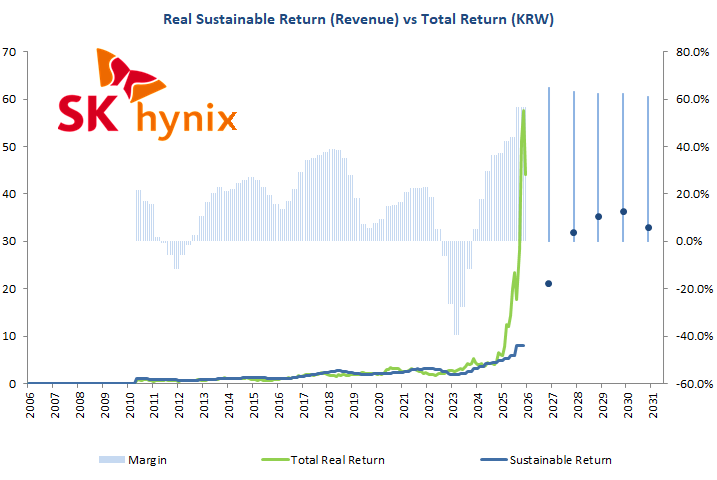
Let’s conclude with a visual. Here are a couple of graphs which show the recent 1 000% stock price rises (green lines) for Micron and SK Hynix – two poster children for the AI trade – in the context of their own history and fundamentals, with the current consensus forecasts for the next 5 years. The multi-trillion-dollar question: Is this AI supercycle sustainable?